Text: Heinz Playner
9 November 2025
Er suchte das Ursprüngliche, das Reine –
und schuf dabei eine der
einflussreichsten Bildsprachen der
Moderne.
Paul Gauguin, der ewige Reisende
zwischen Paris und der Südsee,
verwandelte seine Sehnsucht in Farbe.
Magazine about art and art market
Paul Gauguin
Flucht in Farbe
You might also be interested in:
Escape in Color
Zwischen Börse und Bretagne
Bevor er zum Mythos wurde, war Paul
Gauguin (1848–1903) ein Pariser
Börsenmakler. Mit der Wirtschaftskrise
von 1882 endete sein bürgerliches
Leben, und er begann zu malen –
zunächst im Stil der Impressionisten,
bald jedoch gegen sie.
In der Bretagne fand er, was er suchte:
einfache Formen, archaische
Frömmigkeit und kräftige Farben. Dort
formte sich der Synthetismus – Gauguins
Idee einer Kunst, die das Sichtbare und
das Unsichtbare, Farbe und Gefühl, in
symbolischer Harmonie vereint.
Self-Portrait with the yellow Christ
1890-1891
Musée d’Orsay, Paris
photocredit: Tanja Playner
In diesem Selbstbildnis verknüpft
Gauguin sein Gesicht mit dem Motiv des
„Gelben Christus“, das im Hintergrund
schwebt. Er zeigt sich als moderner
Märtyrer – ein Künstler, der sich für seine
Überzeugung opfert.
Farbe wird zur Metapher. Das Gelb steht
für Glauben, aber auch für Isolation.
Gauguin inszeniert sich hier als
spiritueller Prophet einer neuen Kunst.
Arles - Zwei Genies im Konflikt
Im Herbst 1888 lebt Gauguin mit Vincent
van Gogh in Arles. Zwei Visionäre, zwei
Temperamente – eine explosive
Mischung.
Van Gogh arbeitet impulsiv, Gauguin
konzeptionell. Die Spannungen
kulminieren im berüchtigten Streit, nach
dem Van Gogh sich das Ohr abschneidet.
Gauguin flieht.
Trotz des Bruchs bleibt die Zeit prägend:
Beide Künstler entwickeln in diesen
Monaten die Sprache der Moderne weiter
– expressiv, farbgewaltig, persönlich.
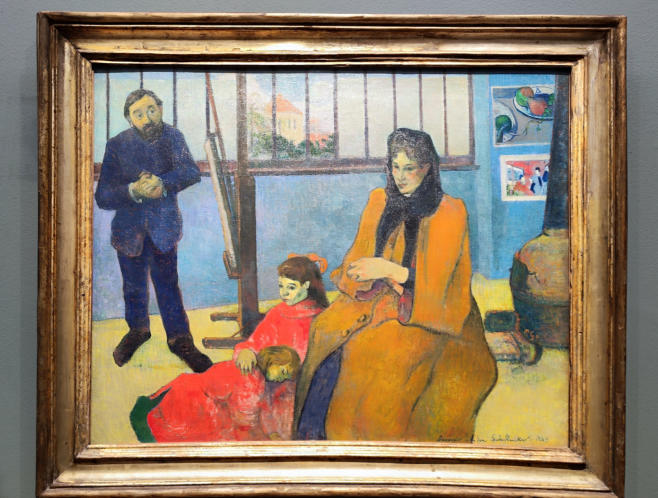
L‘atelier de Schuffenecker
1889
Musée d’Orsay, Paris
photocredit: Tanja Playner
Ein Atelier voller Gemälde, Figuren und
Symbole – und im Zentrum der Künstler
Émile Schuffenecker, ein Freund
Gauguins. Das Werk ist mehr als ein
Interieur: Es ist eine Reflexion über den
Künstler als Schöpfer, über Inspiration
und Einfluss.
Gauguin mischt hier Realität und
Vorstellung. Das Atelier wird zum
Mikrokosmos der Kunst – ein Ort
zwischen Ordnung und Traum.
Tahiti – Das erfundene Paradies
1891 lässt Gauguin Europa hinter sich.
Tahiti wird sein Sehnsuchtsort – und
seine Bühne.
Er sucht das „Unverdorbene“, das
„Natürliche“, findet aber eine vom
Kolonialismus geprägte Gesellschaft.
Seine Bilder idealisieren die Insel und ihre
Bewohnerinnen, aber sie zeugen auch
von intensiver Empathie und spiritueller
Neugier.
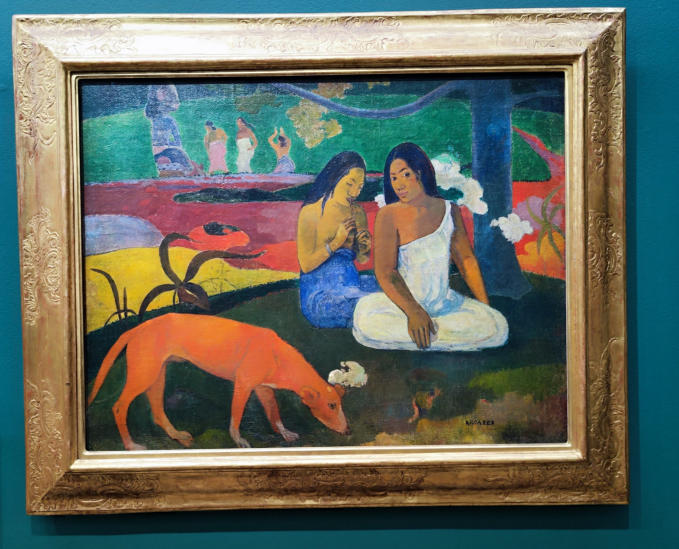
Arearea (Freude)
1892
Musée d’Orsay, Paris
photocredit: Tanja Playner
Zwei Frauen sitzen in ruhiger Pose, ein
roter Hund liegt im Vordergrund. Die
Landschaft ist still, die Farben leuchten:
Rot, Grün, Ocker. Arearea bedeutet
„Freude“ – doch die Szene wirkt
gleichzeitig entrückt und melancholisch.
Gauguin zeigt nicht das Äußere Tahitis,
sondern eine innere Stimmung – ein
Gleichgewicht zwischen Natur, Mythos
und Traum.
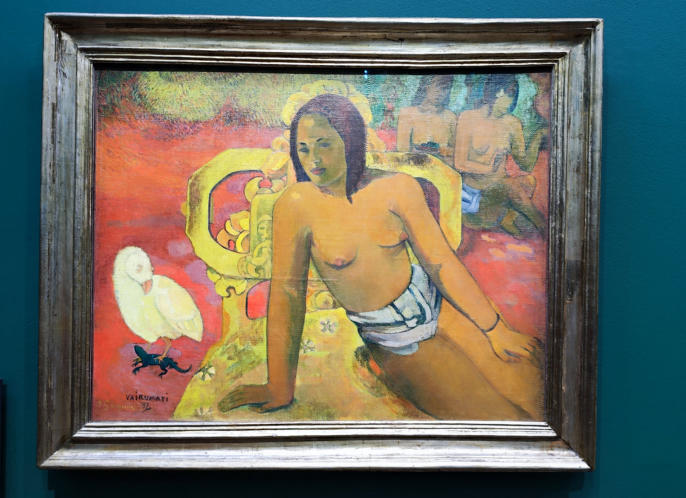
Vairumati
1897
Musée d’Orsay, Paris
photocredit: Tanja Playner
Die tahitianische Göttin Vairumati steht
im Mittelpunkt, in einem tropischen
Garten aus intensiven Farben. Ihre
Haltung erinnert an antike Madonnen –
eine Verbindung von westlicher Symbolik
und polynesischer Mythologie.
Gauguin erschafft hier eine moderne
Ikone. Farbe ersetzt Linie, Spiritualität
ersetzt Dogma. Das Werk zeigt seine
Fähigkeit, Kulturen zu verschmelzen –
und gleichzeitig seine eurozentrische
Perspektive.
And the Gold of Their Bodies
1901
Musée d’Orsay, Paris
photocredit: Tanja Playner
Zwei nackte Frauen ruhen in goldener
Landschaft, die Haut schimmert im Licht.
Die Farben – sattes Gelb, Kupfer, Grün –
scheinen von innen heraus zu leuchten.
Ein spätes Werk voller Sinnlichkeit und
Symbolik. Gauguin verklärt den Körper
zur mythischen Form, aber zwischen
Begehren und Spiritualität bleibt
Spannung. Das Bild ist gleichzeitig schön
und beunruhigend – wie Gauguins
Weltbild selbst.
Ein Erbe in Farbe
Als Gauguin 1903 auf den Marquesas-
Inseln starb, war er einsam, krank und
verkannt. Erst Jahre später sah man in
ihm den Revolutionär, der die Kunst von
der sichtbaren Welt befreit hatte.
Seine leuchtenden Flächen, seine
symbolische Farbigkeit und sein Mut zur
Subjektivität prägten die Moderne.
Picasso, Matisse und die Expressionisten
sahen in ihm einen Wegbereiter – einen,
der Farbe zum Denken brachte.
Paul Gauguin malte nicht, was er sah –
sondern, was er fühlte.
Zwischen Flucht und Erkenntnis, Mythos
und Moderne, bleibt er einer der
faszinierendsten Grenzgänger der
Kunstgeschichte.
Seine Bilder sind Bekenntnisse in Farbe –
und Spiegel einer unstillbaren Sehnsucht
nach Wahrheit.
„Ich schließe die Augen, um zu sehen.“
– Paul Gauguin
Text: Heinz Playner
9 November 2025
He sought the primal, the pure – and in
doing so created one of the most
influential visual languages of modern
art.
Paul Gauguin, the eternal traveler
between Paris and the South Seas,
transformed his longing into color.
Between the stock exchange and
Brittany
Before he became a legend, Paul
Gauguin (1848–1903) was a Parisian
stockbroker. The economic crisis of 1882
brought his bourgeois life to an end, and
he began to paint—initially in the style of
the Impressionists, but soon in
opposition to them.
In Brittany, he found what he was looking
for: simple forms, archaic piety, and
vibrant colors. There, Synthetism took
shape—Gauguin's idea of an art that
unites the visible and the invisible, color
and emotion, in symbolic harmony.
In this self-portrait, Gauguin links his face
to the motif of the "Yellow Christ," which
hovers in the background. He presents
himself as a modern martyr—an artist
sacrificing himself for his convictions.
Color becomes a metaphor. The yellow
represents faith, but also isolation.
Gauguin portrays himself here as a
spiritual prophet of a new art.
Arles - Two Geniuses in Conflict
In the autumn of 1888, Gauguin lived with
Vincent van Gogh in Arles. Two visionaries,
two temperaments—an explosive mix.
Van Gogh worked impulsively, Gauguin
conceptually. The tensions culminated in the
infamous argument after which Van Gogh
cut off his ear. Gauguin fled.
Despite the break, the period remained
formative: During these months, both artists
further developed the language of
modernism—expressively, with vibrant
colors, and personally.
An artist's studio filled with paintings,
figures, and symbols—and at its center,
the artist Émile Schuffenecker, a friend of
Gauguin's. The work is more than just an
interior: it's a reflection on the artist as
creator, on inspiration and influence.
Gauguin blends reality and imagination
here. The studio becomes a microcosm
of art—a place between order and
dream.
Tahiti – The Imaginary Paradise
In 1891, Gauguin left Europe behind.
Tahiti became his place of longing—and
his stage.
He sought the "unspoiled," the "natural,"
but found a society shaped by
colonialism. His paintings idealize the
island and its inhabitants, but they also
bear witness to intense empathy and
spiritual curiosity.
Two women sit in a serene pose, a red
dog lies in the foreground. The landscape
is still, the colors vibrant: red, green,
ochre. Arearea means "joy"—yet the
scene simultaneously seems
otherworldly and melancholic.
Gauguin doesn't depict the external
reality of Tahiti, but rather an inner
mood—a balance between nature, myth,
and dream.
The Tahitian goddess Vairumati is the
central figure in a tropical garden of
intense colors. Her pose is reminiscent of
ancient Madonnas—a fusion of Western
symbolism and Polynesian mythology.
Gauguin creates a modern icon here.
Color replaces line, spirituality replaces
dogma. The work demonstrates his
ability to fuse cultures—and
simultaneously reveals his Eurocentric
perspective.
Two naked women rest in a golden
landscape, their skin shimmering in the
light. The colors—rich yellow, copper,
green—seem to glow from within.
A late work brimming with sensuality and
symbolism. Gauguin transfigures the
body into a mythical form, yet tension
remains between desire and spirituality.
The painting is both beautiful and
unsettling—much like Gauguin's
worldview itself.
A legacy in color
When Gauguin died in 1903 in the
Marquesas Islands, he was lonely, ill, and
misunderstood. Only years later was he
recognized as the revolutionary who had
liberated art from the visible world.
His luminous surfaces, his symbolic use
of color, and his courage to embrace
subjectivity shaped modernism. Picasso,
Matisse, and the Expressionists saw him
as a pioneer—someone who made color
a force for thought.
Paul Gauguin didn't paint what he
saw—he painted what he felt.
Between escape and enlightenment,
myth and modernity, he remains one of
the most fascinating boundary-crossers
in art history.
His paintings are confessions in
color—and reflections of an
unquenchable longing for truth.
"I close my eyes to see."
– Paul Gauguin